

Who Regulates You After AMLAR?
For Most Firms, the Answer Is About to Change
On 15 September 2026, the UK Government published its Anti-Money Laundering and Asset Recovery Strategy (AMLAR) for 2026-2029 — a three-year roadmap backed by £520 million and 500 new officers across policing, the NCA and the CPS. Buried within it is a structural change that will reshape AML compliance in the UK regardless of sector: the number of AML supervisors is being cut from 25 down to just 3 — the FCA, HMRC, and the Gambling Commission.
If your firm is currently overseen by one of the 22 professional body supervisors being wound down, this is not a distant policy detail. It is a direct, near-term question about who will regulate you, under what expectations, and how soon.
What AMLAR actually changes
The strategy is built around two stated principles. Integrate — the Government sharing information and working across agencies to spot suspicious activity sooner. Empower — giving the system better people, training, technology and legal powers, while removing the barriers that slow enforcement down. In practice, that translates into several concrete commitments over the strategy's first year (2026/27):
Consolidating AML supervision from 25 bodies to 3, a fundamental restructuring of who firms answer to
Reviewing the Suspicious Activity Report (SAR) regime, aimed at reducing low-value reporting and sharpening its intelligence value
Consulting on strengthened supervisory enforcement powers, and on whether to expand the regulatory perimeter to additional sectors
New information-gathering powers for the UK Financial Intelligence Unit, via legislation when Parliamentary time allows
More specialist policing capacity dedicated specifically to exploiting SAR intelligence
This sits alongside, not instead of, the 2026 amendments to the Money Laundering Regulations 2017, already in force since 30 June, which narrowed Enhanced Due Diligence obligations to FATF's "High-Risk Jurisdictions subject to a Call for Action" list. This doesn't remove EDD duties for jurisdictions on FATF's "Increased Monitoring" (grey) list — it just stops mandating EDD automatically for them; grey-listed does not mean low-risk.
Why this is happening now
The Government's own figures make the case for urgency: 3,158 system-wide illicit finance disruptions in 2025/26, up 15% year on year, and 4,085 money laundering convictions, up 11%. Progress is real, but three years on from Economic Crime Plan 2, the direction of travel is toward consolidation and enforcement capacity, not incremental guidance updates. The timing isn't arbitrary, either: the UK faces its next FATF evaluation in August 2027, and the government has explicitly framed this consolidation as part of demonstrating a more robust, consistent supervisory system ahead of that review. Reducing 25 supervisors to 3 is a direct answer to a long-standing criticism of the UK's fragmented AML landscape — but it also means firms currently supervised by a smaller, sector-specific body should expect a materially different supervisory relationship within this parliament.
What compliance and risk leaders should be prioritising
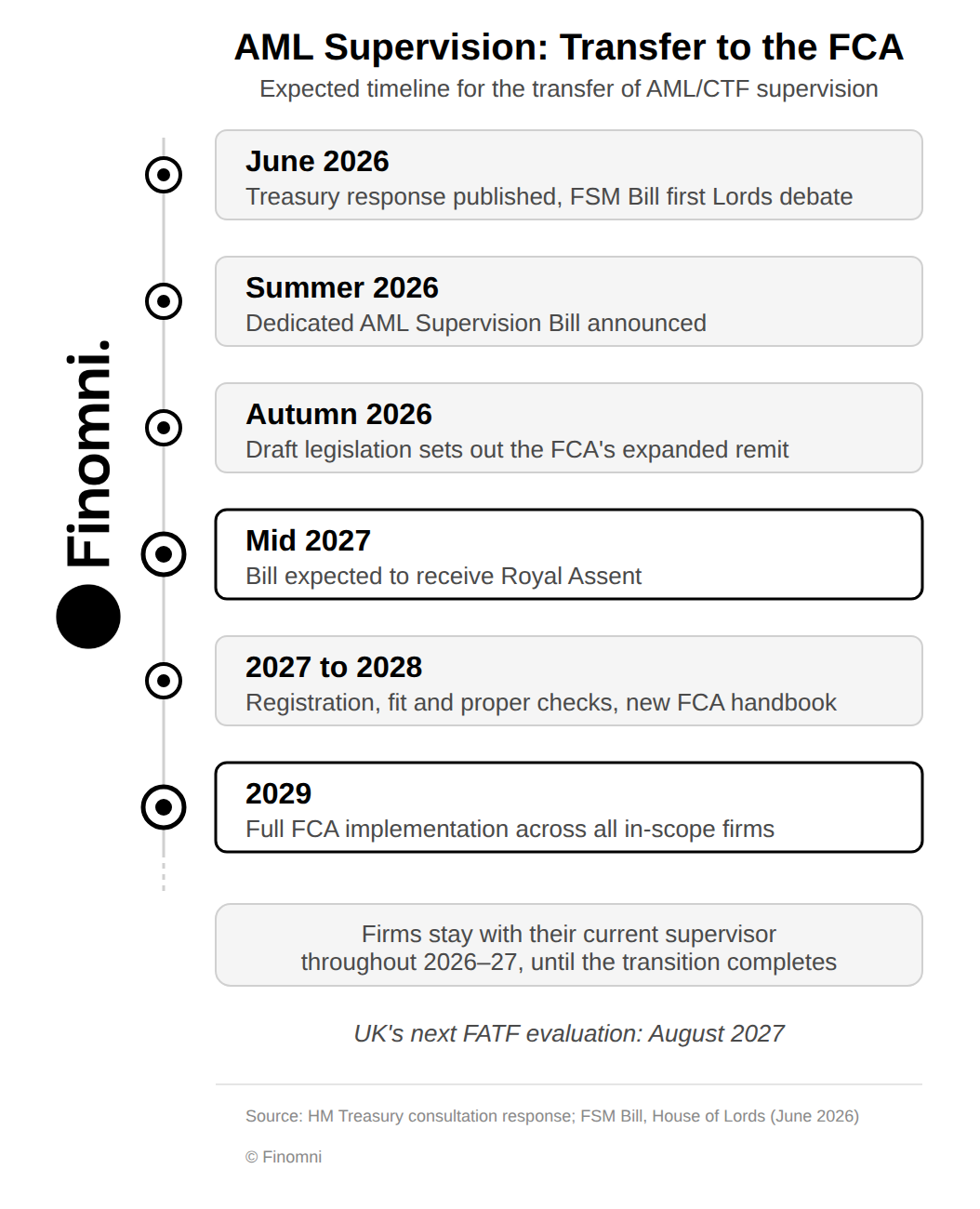
Know your new supervisor and the timeline. This isn't three new bodies emerging — it's the FCA absorbing the 22 professional body supervisors (covering legal and accountancy firms) plus the trust-and-company-service-provider and default accountancy supervision currently sitting with HMRC, while HMRC retains its other AML functions and the Gambling Commission is unaffected. If you're currently supervised by a professional body or by HMRC as a trust or company service provider, you're moving to the FCA. If the Gambling Commission or FCA already directly supervises you, expect continuity of supervisor but a stricter, more resourced regime around you. The graphic below sets out the expected transition timeline.
Prepare for outcomes-based scrutiny, not documentary compliance. Every major AML development this year — AMLAR, the Money Laundering Regulations update, FATF's own gambling review — points the same way: regulators want demonstrable effectiveness, not policies that exist only on paper. Benchmark your existing controls against that standard now, well ahead of any formal transition.
Review SAR quality, not just volume. With the SAR regime under direct review to cut low-value reporting, firms whose suspicious activity reporting leans toward high-volume, low-quality filings should expect this practice to draw more scrutiny, not less.
Watch the regulatory perimeter consultation closely. If your sector isn't currently in AML scope, that may not remain true for the length of this strategy.
Brief the board now. Senior management should understand what supervisory consolidation means for governance and reporting lines well before registration and fit-and-proper assessments land in 2027–2028.
Closing the gap requires more than knowing the direction of travel
Knowing that supervision is consolidating is the easy part. Being ready for it is harder — and means answering the questions above credibly, not just being aware of them. For most firms that means a structured review: mapping the current and future supervisory landscape, benchmarking controls against an outcomes-based standard, and strengthening SAR quality and governance reporting well before any transition takes effect.
The wider picture
AMLAR arrives alongside FATF's own recent shift toward effectiveness-based standards in sectors like gambling, and the EU's AMLA rollout — all pointing toward the same global direction: financial crime controls are being judged on whether they work, not whether they exist. Firms that treat AMLAR as a UK-specific policy update risk missing that it is one part of a much broader, converging regulatory expectation.
Compliance and risk leaders should not wait for their supervisor to formally change before acting. Reviewing readiness now, while the transition timeline is still being worked out, is a materially stronger position than reacting once a new supervisor's expectations are already in force.