

The Missing Chapter: Financial Crime and the IFR’s State of the Game
The Independent Football Regulator's first State of the Game report represents a critical step on the road to building a more sustainable future for a sport which is so fundamental to the social fabric of this country. It is the most comprehensive financial analysis of the English football industry ever undertaken.
When the report launched on 13 October, the coverage, the regulator's own press release and the Culture Secretary's statement to Parliament focused on solvency and revenue distribution. Financial crime barely featured. Yet read the same evidence through a financial crime lens and a second story emerges. English football is loss-making, dependent on owner cash, increasingly owned through complex international structures, and spending more than ever through intermediaries. Those are precisely the conditions that money launderers, sanctions evaders and corrupt actors look for.
The report itself acknowledges this. Drawing on the UK's 2025 National Risk Assessment, it describes football as "an attractive target for criminals, kleptocrats and other malign actors", and warns that clubs in financial distress "may be vulnerable to exploitation by criminals offering easy money in return for ongoing access".
Five findings that matter for financial crime
1. Clubs live on owner cash. In 2025/26, 94% of clubs in the top five leagues were loss-making. Two thirds could not survive 90 days without new owner funding, and 29% could not last 30 days. 28 clubs received 12 or more owner injections in a single year. Every injection is a source-of-funds event. Yet scrutiny under the IFR's owners' test is strongest at the point of purchase, with existing owners reviewed mainly when a concern is triggered.
2. Ownership is more complex and more international. There were 78 ownership transactions worth £7.2bn between 2021 and 2025. Non-domestic owners now control 75% of Premier League revenue, and 57% of Premier League and EFL clubs have a minority investor. The report notes the growing use of multiple holding companies for clubs, stadia and training grounds, some "based in different jurisdictions". Each layer is a place where beneficial ownership can be obscured. And 85% of Premier League clubs sit in a multi-club or multi-sport group, or have an owner with stakes elsewhere, where transfers, loans and services between related entities can move value at prices no independent party would agree.
3. Distress is widespread. More than 60% of EFL and National League clubs are technically insolvent. The report's case studies, from Bury to Wigan, show how owner withdrawal leads to hurried sales. Distressed clubs are exactly where buyers with unverified wealth find the door open.
4. Money moves through intermediaries and lenders. Fees paid to agents rose from £317m to £548m in four years. Transfer factoring rose from £55m to £779m a year, and club debt is forecast to reach £5.1bn by 2026/27, with private credit a growing source. Agents, lenders and factoring firms put third parties between a club and its money, where ownership and purpose are hardest to check. Agent payments are hard to price and often cross borders, making them a classic channel for bribery and kickbacks.
5. Governance controls are thin. Only 33% of clubs responding to the IFR's survey had an independent non-executive director, and only 35% had a finance, audit or risk committee. At many clubs, the checks that would catch a suspicious payment do not yet exist.
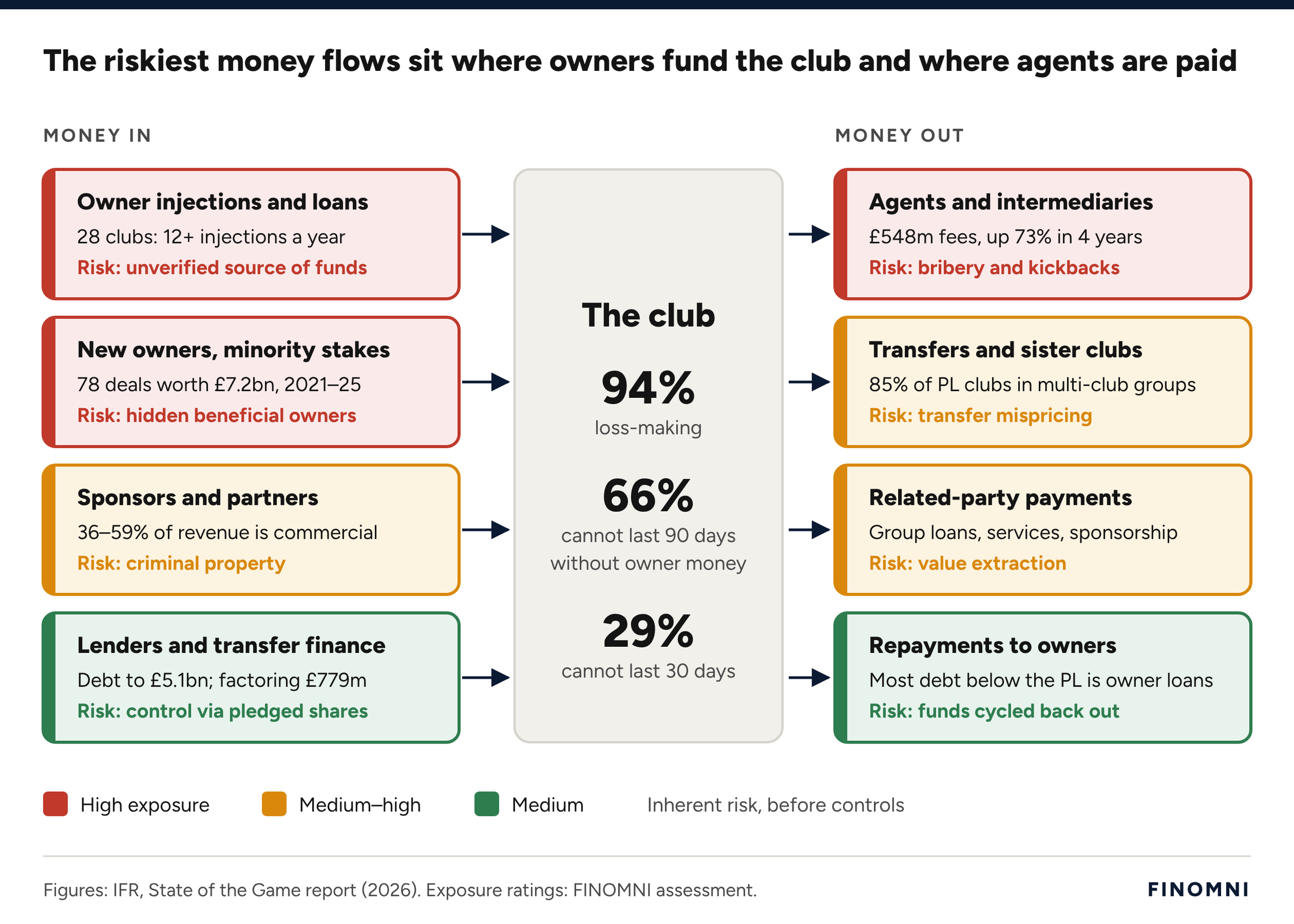
Owner funding, new investors and agent payments are where large sums move most often with the least independent scrutiny.
Regulators are converging
The IFR is not alone. The UK's 2025 National Risk Assessment names football as a target for criminals and kleptocrats. In 2026 the FCA warned clubs that sponsorship money from unauthorised crypto and trading firms may be criminal property. And under the EU's new anti-money laundering rules, professional clubs and football agents in the EU must carry out due diligence on investors, sponsors, agents and player transfers from July 2029.
That leaves a gap. English clubs remain outside the UK's anti-money laundering regime, while their EU counterparts, including sister clubs in multi-club groups, move inside theirs. Expect lenders, counterparties and the IFR to apply those standards to English clubs well before any change in UK law.
Lessons already learned
Chelsea, 2022: when the owner was sanctioned, the club could operate only under a government licence that restricted ticket sales and new contracts until it was sold.
Birmingham City, 2009 to 2014: an owner charged with money laundering in Hong Kong stayed on the board for more than two and a half years, because the test at the time disqualified only owners with unspent convictions.
Wigan Athletic, 2020: days after a new investor took control, he refused to provide the £6 million the club needed, and it entered administration on 1 July. A panel found his funding assurances were "either false or at least knowingly misleading".
How dirty money can move through a club
A simple, illustrative example shows why these numbers matter. A company owned by the club's owner, registered in a secrecy jurisdiction, lends the club £10m. The club records it as an owner loan and spends it on wages and transfers. On paper, the money is now football business: it has passed through a club's accounts, been audited and been filed. Two years later the club repays the loan, but to a different company the owner controls, in another jurisdiction. Money of unknown origin went in. Money with a club's books behind it came out.
Nothing in that chain looks unusual on its own. Owner loans make up most club debt below the Premier League, and repayments to owners are routine. What separates a legitimate loan from laundering is evidence: where the money came from, who received the repayment, and whether anyone at the club asked. The same pattern works through an overpriced sponsorship from a company linked to the owner, or a transfer fee paid to a sister club at a price no independent buyer would agree.
What it means for clubs
The IFR is clear that it is not an anti-money laundering supervisor. But it now holds the levers that matter. Where it suspects funding is linked to serious crime, it can refuse or remove owners, restrict a club from accepting the money, impose penalties and, in the most serious cases, revoke a licence. Financial crime is no longer only a reputational issue for clubs. It is a licensing issue.
The criminal law applies too. Clubs can commit offences by handling criminal property, and face corporate offences if an agent or other associate commits bribery or facilitates tax evasion and the club had no adequate procedures to prevent it. The tax evasion offence applies to every club, whatever its size.
The IFR's timetable will bring this into focus quickly. Clubs must agree plans to meet its financial resources requirement before the 2027/28 season, publish their first corporate governance statements from October 2027, and stress test the loss of owner funding by May 2028. Full licences follow by May 2030.
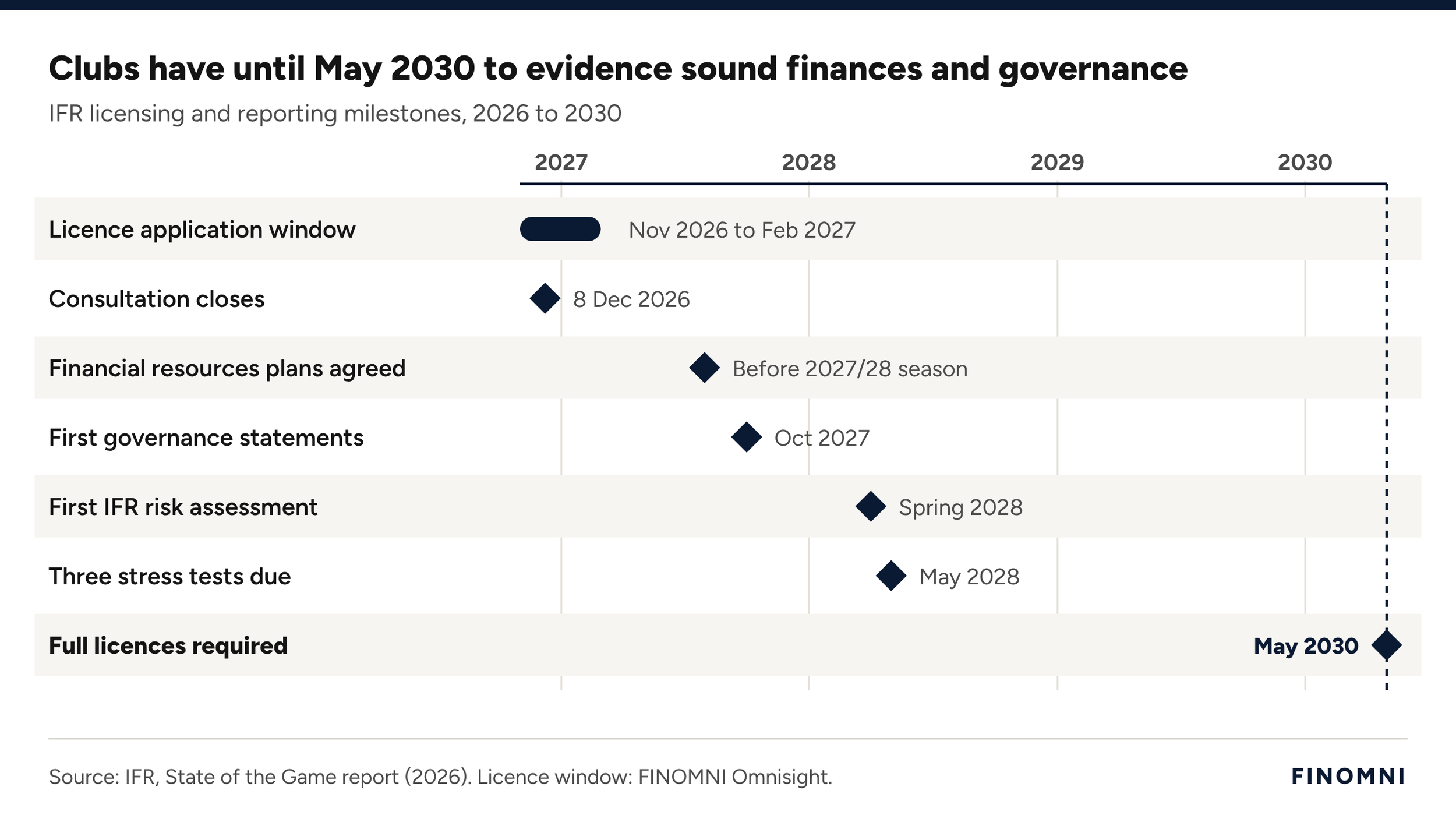
Each of those milestones will require clubs to answer the same questions:
Where does our money come from, and can we evidence it, injection by injection?
Who really owns and controls us, through every layer of the structure?
Who are our sponsors, lenders and agents, and what checks have we done on them?
How does our board oversee money laundering, sanctions, bribery and tax evasion risk?
Clubs that can answer those questions now will be better placed with the regulator, with lenders and with investors. Clubs that cannot will find the answers being asked for under deadline pressure.
Your bank will ask first
English clubs sit outside the UK's anti-money laundering regulations, so they have no legal duty to report suspicious activity. Their banks do. A bank that cannot see where an owner's injection came from, or why a fee is going to an unrelated company abroad, must consider reporting it to the National Crime Agency, and may need consent before it can process the payment. That can hold money for days or weeks, and it can lead a bank to review whether it wants the club as a customer at all.
For an industry where two thirds of clubs cannot last 90 days without owner money, a held payment is a cash-flow problem long before it is a regulatory one. Clubs that can hand their bank a clear evidence file get through these questions quickly. Clubs that cannot may find their bank acting before the IFR does.
Where to start
Three steps put any club on a credible footing, whatever its size:
Name one senior person accountable for financial crime.
Build a source-of-wealth file for every owner and investor.
Screen owners, lenders, sponsors and agents against sanctions lists.
The same evidence supports IFR licensing, refinancing, bank relationships and any future sale.
FINOMNI's consultation response
The report is a consultation draft, with comments due by 8 December 2026. FINOMNI intends to respond. The draft treats illicit finance in a single box and frames it mainly as an entry test for owners. The IFR's six-point action plan says clubs must improve how they manage financial risk. Our response will argue that financial crime risk belongs inside that work, because it runs through club funding, transfers and commercial income every season, and will ask the IFR to:
require ongoing, risk-based scrutiny of owner funding, not just checks at the point of purchase
look through every layer of ownership to the individuals behind it, including minority investors and politically exposed persons
make sanctions screening of owners, investors, lenders and major partners a licence expectation
set clear expectations for due diligence and payment controls over agents and intermediaries
issue guidance on due diligence for sponsors and commercial partners
apply the full owners' test to distressed sales and to lenders taking control
name money laundering, sanctions, bribery and tax evasion explicitly in the Club Code's risk oversight principle
Integrity is part of sustainability
The State of the Game report sets the foundations for how English football will be regulated for the next decade. Its focus on financial sustainability is right, but sustainability and integrity cannot be separated. A club that cannot evidence where its money comes from, who it does business with, or how its board oversees those risks is not financially sound, however strong its balance sheet.
We would welcome perspectives from clubs, investors, lenders, agents and supporter groups as we finalise our submission, so that it reflects the realities of the game and helps build a regime that protects clubs, their communities and the integrity of English football.
FINOMNI's 8-page executive briefing on the report, with a risk map, case studies and a maturity framework for clubs, is available on request. Please contact us for a copy.