

Iran conflict: How the war is reshaping financial-crime risk
Geopolitical Financial Crime Intelligence Briefing
The current Iran conflict environment is no longer simply a sanctions issue. It is reshaping how organisations need to think about proliferation financing (PF), terrorist financing (TF) and sanctions evasion across trade, payments, procurement, logistics and correspondent banking ecosystems.
For many firms, existing control frameworks were designed around identifying direct exposure to sanctioned entities. That model is becoming increasingly ineffective against modern sanctions-evasion typologies emerging from the current conflict environment.
The risk is rarely direct.
Increasingly, exposure is concealed within legitimate commercial activity through:
front companies obscuring ownership and beneficiary relationships;
intermediary trading structures distancing sanctioned actors from transactions;
re-export jurisdictions concealing origin, destination or end-user exposure;
maritime deception techniques including ship-to-ship transfers, AIS manipulation and flag hopping;
layered payment routing designed to obscure the movement of funds across multiple entities or jurisdictions; and
digital-asset infrastructure facilitating cross-border settlement activity outside traditional banking visibility.
The operational challenge is that these structures are often designed to appear commercially ordinary.
Geopolitical fragmentation is reshaping financial-crime exposure
Geopolitical fragmentation is increasing while commercial interdependence remains intact.
While the US, UK and Europe continue expanding sanctions and anti-circumvention enforcement, many jurisdictions across Asia, the Middle East and emerging markets remain commercially connected to Iranian-linked trade flows, energy markets and intermediary structures.
At the same time, the conflict environment is increasing pressure across:
Strait of Hormuz shipping activity;
oil-routing and commodity-trading infrastructure;
maritime insurance and shipping networks;
correspondent banking relationships; and
non-dollar payment and settlement channels.
FATF continues to classify Iran as a high-risk jurisdiction for AML, TF and PF concerns. That position increasingly shapes supervisory expectations across global financial centres, including jurisdictions attempting to balance commercial connectivity with growing pressure to strengthen financial-crime controls.
The result is a more complex operating environment for multinational organisations:
enforcement pressure is increasing across correspondent banking, trade finance and sanctions compliance;
regulators are placing greater emphasis on indirect exposure and facilitation risk; and
uneven geopolitical alignment is creating inconsistent sanctions exposure across markets and supply chains.
Exposure continues to move through legitimate trade and financial infrastructure even where there is no direct Iranian counterparty relationship.
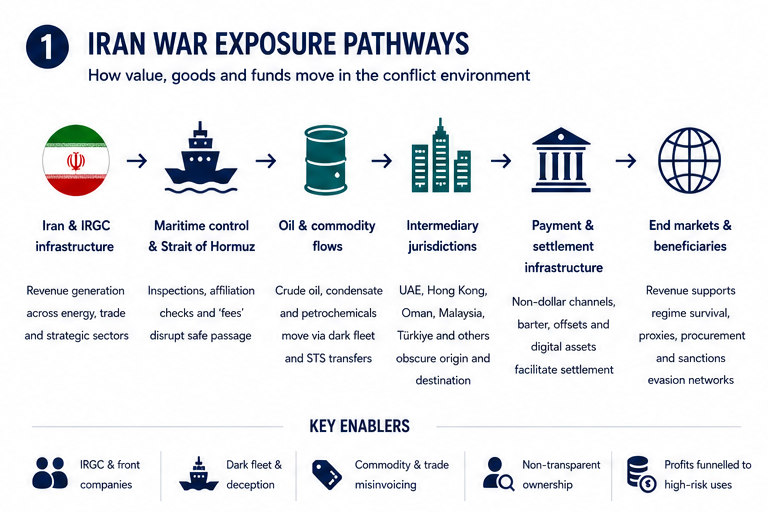
Figure 1. Iran War Exposure Pathways
The conflict environment is reshaping how value, goods and funds move across the global financial system. Iranian-linked exposure increasingly flows through maritime chokepoints, dark fleet shipping, intermediary jurisdictions and non-dollar settlement infrastructure designed to obscure origin, ownership and beneficiary relationships.
Traditional sanctions frameworks are struggling with concealed nexus
Many sanctions frameworks remain calibrated for direct exposure rather than concealed facilitation risk.
Static screening and jurisdiction-based risk models continue to play a role, but current Iran-linked typologies increasingly exploit the limitations of these controls through intermediaries, layered ownership structures and commercial activity designed to appear operationally legitimate.
The primary vulnerability is often not failure to identify sanctioned names.
It is failure to identify concealed nexus embedded within otherwise lawful trade, logistics and payment activity.
Exposure increasingly emerges through:
unusual trade routing lacking commercial rationale;
intermediary-heavy transaction structures obscuring beneficiary relationships;
opaque ownership arrangements limiting visibility over ultimate control;
transshipment activity disguising origin or destination; and
commodity and shipping flows inconsistent with ordinary market behaviour.
The operational challenge for financial-crime teams is increasingly contextual rather than technical.
The question is no longer simply whether a transaction matches a sanctions list. The question is whether the broader commercial ecosystem surrounding the activity makes sense operationally, economically and geopolitically.
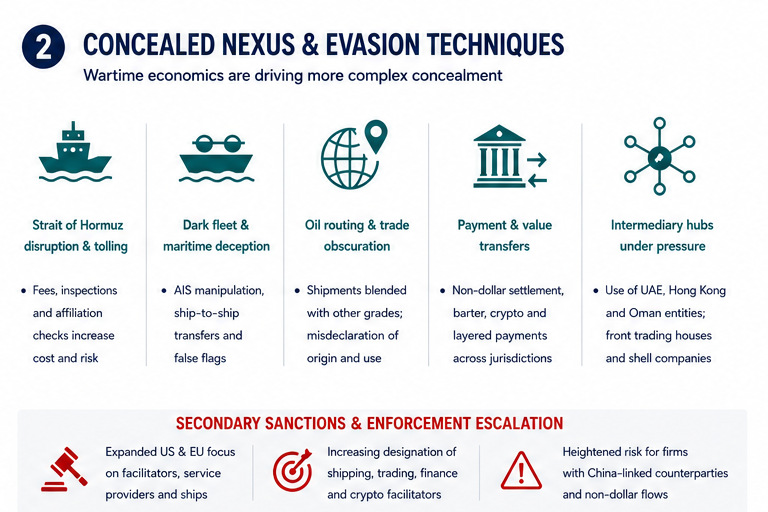
Figure 2. Concealed Nexus & Evasion Techniques
Current Iran-linked sanctions-evasion methodologies increasingly rely on layered routing, intermediary hubs, maritime deception and fragmented payment infrastructure. Exposure is often concealed through commercially legitimate structures designed to obscure geopolitical nexus and beneficiary control.
PF, TF and sanctions risk are converging operationally
The distinction between PF, TF and sanctions exposure is becoming less operationally clear.
Historically, proliferation financing was treated largely as an export-controls issue, while terrorist financing frameworks focused primarily on cash movement, charities or informal remittance activity.
Current geopolitical risk environments increasingly blur those boundaries.
Commercial trade flows, procurement structures, shipping networks and commodity revenues are now routinely assessed by regulators and intelligence authorities as potential mechanisms supporting:
military procurement;
sanctions evasion;
proxy financing;
dual-use acquisition activity; and
broader geopolitical destabilisation.
Trade and maritime infrastructure have become primary vectors for sanctions evasion, PF activity and concealed geopolitical exposure.
Digital assets are increasingly being used as settlement infrastructure within broader sanctions-evasion and cross-border value-transfer ecosystems, particularly where traditional financial channels face restriction or scrutiny.
This convergence creates significant pressure on organisations still operating fragmented control environments where AML, sanctions, PF and trade-compliance functions remain operationally siloed.
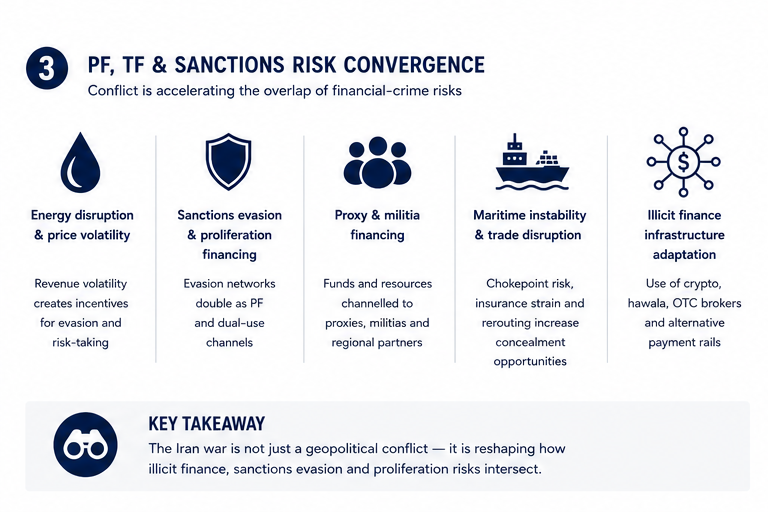
Figure 3. PF, TF & Sanctions Convergence
The Iran conflict is accelerating the convergence of sanctions evasion, PF activity, proxy financing, maritime disruption and illicit value-transfer infrastructure. Financial-crime exposure is increasingly interconnected across operational, geopolitical and commercial ecosystems.
Emerging control vulnerabilities
Many sanctions frameworks continue to rely heavily on static screening and jurisdiction-based risk models. Current Iran-linked typologies increasingly exploit this limitation through intermediaries, layered ownership structures, re-export routing and commercial activity designed to appear operationally legitimate.
The primary vulnerability is not failure to identify sanctioned names. It is failure to identify concealed nexus embedded within otherwise lawful trade, logistics and payment activity.
Trade-finance and maritime infrastructure remain key exposure vectors
Trade and maritime infrastructure continue to provide effective concealment pathways for sanctions evasion and PF activity.
Exposure increasingly emerges through:
ship-to-ship transfers;
manipulated cargo documentation;
opaque shipping ownership structures;
intermediary-heavy procurement chains; and
routing through transshipment and re-export jurisdictions.
Many control environments remain documentation-led rather than intelligence-led, limiting the ability to identify commercial implausibility or concealed beneficiary relationships.
Digital-asset exposure is becoming more operationally significant
Digital assets are increasingly being used as settlement infrastructure within broader sanctions-evasion and cross-border value-transfer networks.
The exposure challenge is often indirect. Firms may interact with layered transactional ecosystems involving OTC brokers, intermediary wallets, mixers or high-risk exchanges without direct visibility into the underlying nexus.
Traditional wallet-screening approaches are unlikely to provide sufficient visibility where exposure sits several layers removed from the originating activity.
Governance structures remain operationally fragmented
In many organisations, geopolitical financial-crime exposure remains siloed between sanctions, AML, trade compliance and operational risk functions.
This creates reduced visibility across interconnected exposure areas including:
procurement;
treasury;
trade finance;
correspondent banking;
logistics; and
third-party management.
PF, TF and sanctions exposure now have direct implications for:
market access;
liquidity and correspondent banking relationships;
supply-chain resilience;
regulatory scrutiny;
investor confidence; and
reputational risk.
Board and senior leadership oversight is becoming increasingly important because many exposure decisions now sit outside compliance functions entirely — within procurement, treasury, operations, trade finance and commercial strategy.
The organisations responding most effectively are increasingly those integrating geopolitical risk directly into enterprise financial-crime governance, executive decision-making and operational risk management frameworks.
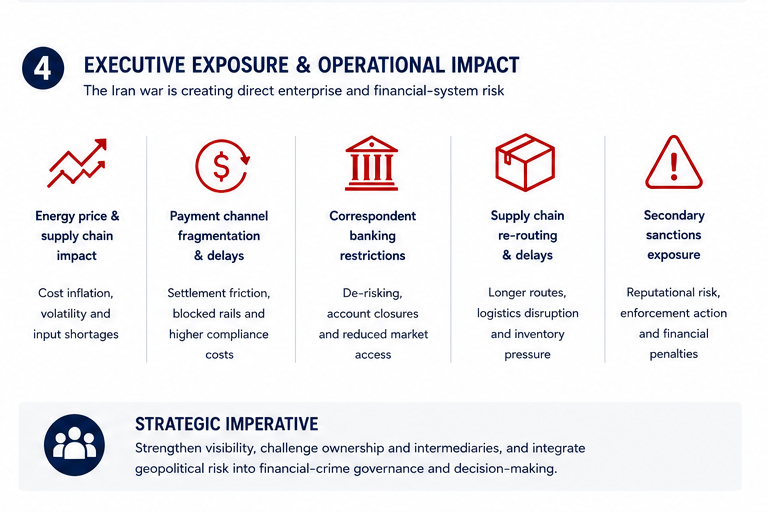
Figure 4. Executive Exposure & Operational Impact
The Iran war is creating direct enterprise exposure across payments, procurement, shipping, supply chains and correspondent banking relationships. Geopolitical financial-crime risk increasingly requires board-level visibility and integrated operational oversight.
Strategic implication for financial-crime teams
The broader lesson from the Iran conflict is that geopolitical instability can no longer sit outside the financial-crime framework.
PF, TF and sanctions exposure are increasingly embedded within legitimate global commerce. Organisations that continue relying on siloed or heavily rules-based compliance structures are likely to face increasing difficulty as regulators focus less on technical screening capability and more on whether firms can identify concealed facilitation risk operationally.
The core regulatory expectation is shifting from sanctions identification toward detection of concealed geopolitical financial-crime exposure embedded within trade, payments, procurement and supply-chain ecosystems.
The firms likely to be most resilient over the coming years will not necessarily be those with the largest compliance functions, but those with the strongest visibility over how geopolitical disruption translates into operational financial-crime exposure.
We support boards, executive teams and financial-crime functions through intelligence-led geopolitical financial-crime assessments, executive threat briefings and sanctions, PF and facilitation-risk analysis across complex operating environments.
If these developments are raising questions for your organisation, please get in touch.